: 4 JUNE 2026, THURSDAY, 9:49:32
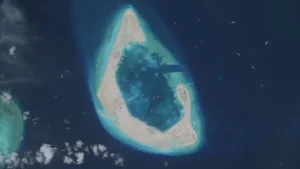
Antelope Reef is a small, teardrop-shaped island in the north-western corner of the South China Sea and, until recently, almost entirely underwater.
But this year it has undergone a dramatic transformation.
Millions of tonnes of sand have been dredged from the sea bed to create solid land. From being only a turquoise speck on the map, Antelope Reef now appears as a 6-sq-km (2.3-sq-mile) crescent of gleaming white sand, with a scattering of buildings in one corner. All in just six months.
In the lagoon formed by the crescent dozens of ships can be seen. These are almost certainly cutter suction dredgers, of which China has the world’s largest fleet: some of them can scoop up 6,000 cubic metres an hour, enough to fill two Olympic-sized swimming pools.
The extraordinary speed of this dredging operation is probably some kind of world record.
But China is not the only one doing this.
After years of watching China creating land to back its expansive territorial claims Vietnam too is now building up some of the reefs it holds in the South China Sea. To a lesser extent other claimants, like the Philippines, are doing the same.
Antelope Reef is in the Paracel Islands, which, together with the Spratlys, are disputed territory, claimed by China, Taiwan, Vietnam, the Philippines, Malaysia and Brunei.
Most of the islands are, as Antelope was until this year, submerged reefs which in the past had no human settlements. China took control of the Paracels back in 1974, after a fierce battle with what were then South Vietnamese forces.
More recently it dredged three reefs in the Spratlys – Mischief, Fiery Cross and Subi – turning them into islands big enough to construct airports and military bases, and claiming almost the entire South China Sea as its sovereign territory within the infamous nine-dash line it has drawn on the map.
Swarms of Chinese coastguard and maritime militia ships now patrol inside the nine-dash line, overwhelming attempts by other claimants to challenge Chinese supremacy. In recent years there have been several clashes with the much smaller Philippines coastguard in areas they both claim.
The straight-line edge on one of the newly-made beaches on Antelope Reef suggests China may be building another military-grade runway there, similar to those on Mischief, Fiery Cross and Subi reefs.
But they already have a well-established airstrip nearby on Woody Island. Building another in an area close to the big Chinese military bases on Hainan seems superfluous.
Instead, China may be sending a message to Vietnam.
Most of the claimants have recognised that they’re never going to get to the legally binding document that the code of conduct was always meant to be,” Poling says.
“China just continues to do whatever it wants on the water, eating away at their sovereignty. So what I think you are eventually going to see is a non-binding agreement. But perhaps that will open up diplomatic space for Vietnam, the Philippines and Malaysia and the others to pursue more effective negotiations among themselves without having to go through Asean.”
This now appears to be the new reality in the South China Sea.
It is every country for itself, making the most of what they already control, accepting that China will always be the biggest and most assertive player.

For add

